Overview
In Fall 2025, for the UCLA ENGR 1 Rocket Design course, I led a 4-person group named "Team Team". The project progressed from a training "Tier D" rocket to our flagship "Tier F" design. The mission is to launch a raw egg to 3,000 feet using a G80T-13 engine and recover it completely intact.
2,916 ft
Max Altitude Reached
Success
Egg Recovery Status
Role
Team Lead & CAD Design
Engine
G80T-13
Body Material
Fiberglass (Hand Layup)
Telemetry
BMP388 Sensor
Phase 1: Tier D - The Foundation
Before tackling the advanced rocket, we built a "Tier D" training rocket. This phase was crucial for mastering the foundational skills.
We modeled the rocket in SolidWorks and ran flight simulations in OpenRocket. Under the guidance of graduate TAs, we went through the complete lifecycle: from 3D printing components and verifying aerodynamics to folding the parachute for recovery.
Outcome: A successful launch that boosted our confidence and validated our initial design assumptions.


Phase 2: Tier F - The Challenge
Glass Fiber Manufacturing
Unlike our practice runs, we couldn't use off-the-shelf tubes. We had to manufacture the body tube ourselves using a dual-layer fiberglass hand layup process.
To ensure concentricity, I used a steel pipe as a mold. We struggled initially with air bubbles, but I implemented a quality control process—cutting fastidiously to select only the section with optimal structural integrity.


Aerodynamics @ 500 ft/s²
Our simulations indicated the rocket would withstand acceleration up to $500 ft/s^2$. Realizing that standard elliptical fins would induce excessive drag at these speeds, I redesigned them with a swept-back curve profile. We also optimized the weight by printing the nose cone with minimum infill density.
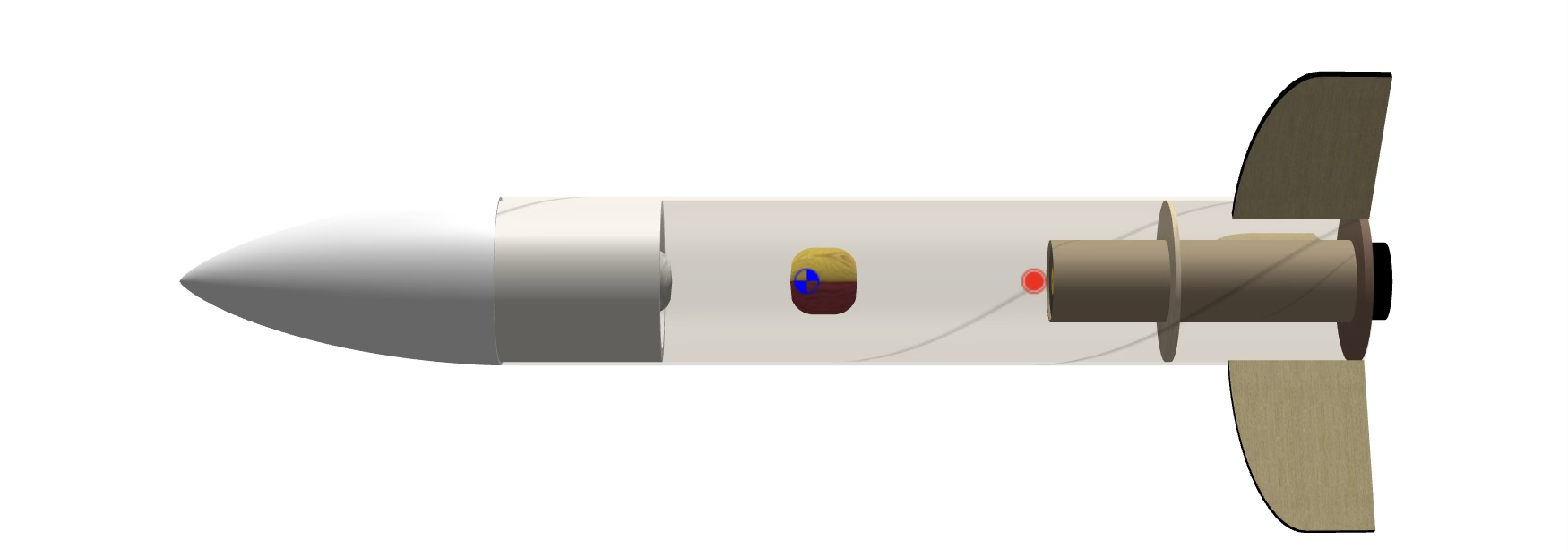

The Egg Protection System
The biggest risk wasn't the ascent, but the deployment shock when the parachute opens. Using Newton's 3rd Law and the elasticity modulus of our shock cord, I calculated the peak instantaneous force.
I proposed a "Graduated Cushion Method" located in the nose cone (away from engine heat). It featured two layers of foam with different densities, a harder outer layer and a softer inner layer, to progressively dampen the G-force spike.


